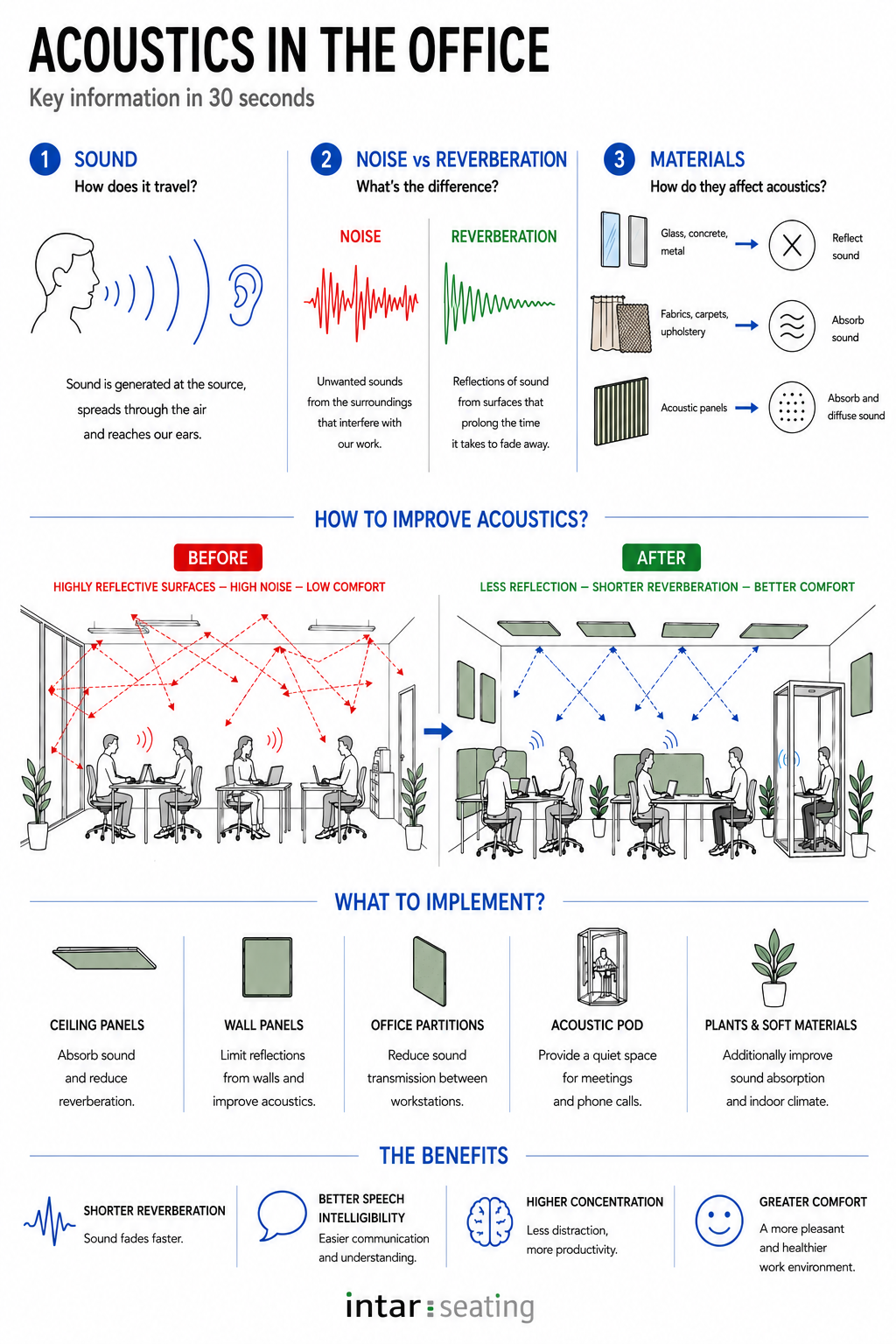
> Office acoustics - part 1
 In a nutshellIntroductionAcousticsSoundNoise / ReverberationMaterialsComfortImproving acousticsSolutionsConclusion
Imagine you are preparing an important proposal or analysing complex data. A colleague nearby is on the phone, another is attending an online meeting, chairs are being moved across the floor, and the printer starts running. None of these sounds is particularly loud, yet after just a few minutes it becomes increasingly difficult to concentrate.
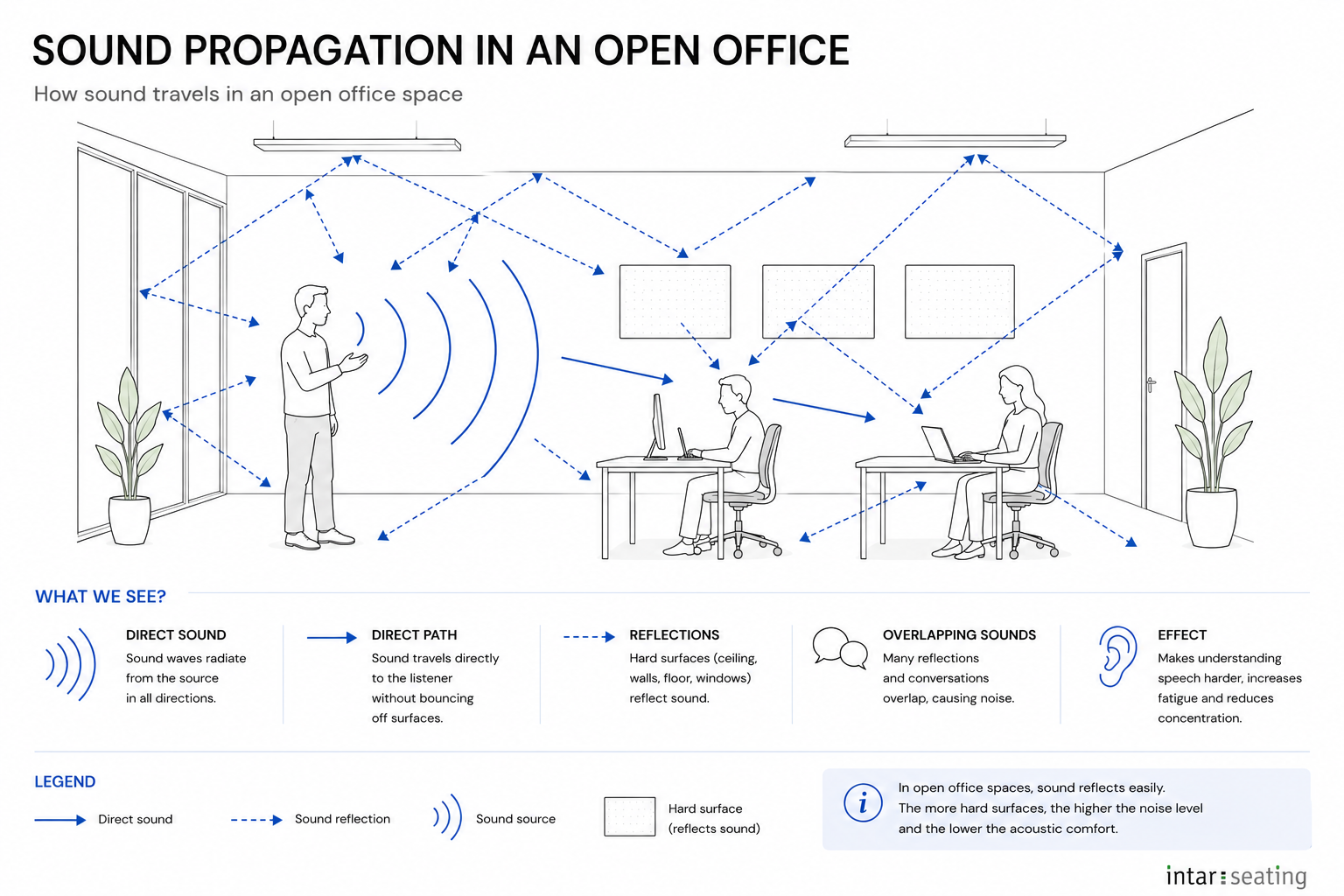
This is a familiar situation in many modern offices. Contrary to popular belief, the problem is not always excessive noise. In many cases, discomfort is caused by the way sound travels through the space. Conversations are reflected by walls, ceilings and glass surfaces, overlapping with one another and remaining audible much longer than expected.
For this reason, office acoustics has become an essential part of workplace design. The objective is not to create complete silence, but to provide an environment where conversations remain clear, focused work is easier, and meetings can take place without disturbing others.
This publication explains the fundamental principles of office acoustics and highlights the key phenomena that influence acoustic comfort in modern workplaces.
Room acoustics is the study of how sound behaves within enclosed spaces and how this affects the people using them. In practice, it focuses on the way sound waves travel, reflect, are absorbed or dispersed after leaving their source.
Until relatively recently, acoustics was mainly associated with concert halls, theatres and recording studios. Today it plays an equally important role in offices, educational facilities, healthcare environments and hospitality spaces.
The widespread adoption of open-plan offices, the increasing use of video conferencing and the popularity of minimalist interiors with extensive glazing have made acoustic comfort one of the key factors influencing workplace quality.
Every conversation, telephone call or movement of a chair generates sound waves that travel in all directions. When these waves encounter a surface, they may be reflected, absorbed or scattered.
The balance between these three behaviours determines how a room sounds. Spaces containing soft, porous materials allow sound energy to dissipate more quickly. Rooms dominated by glass, concrete, steel or stone reflect much of the sound energy, increasing reverberation and reducing acoustic comfort.
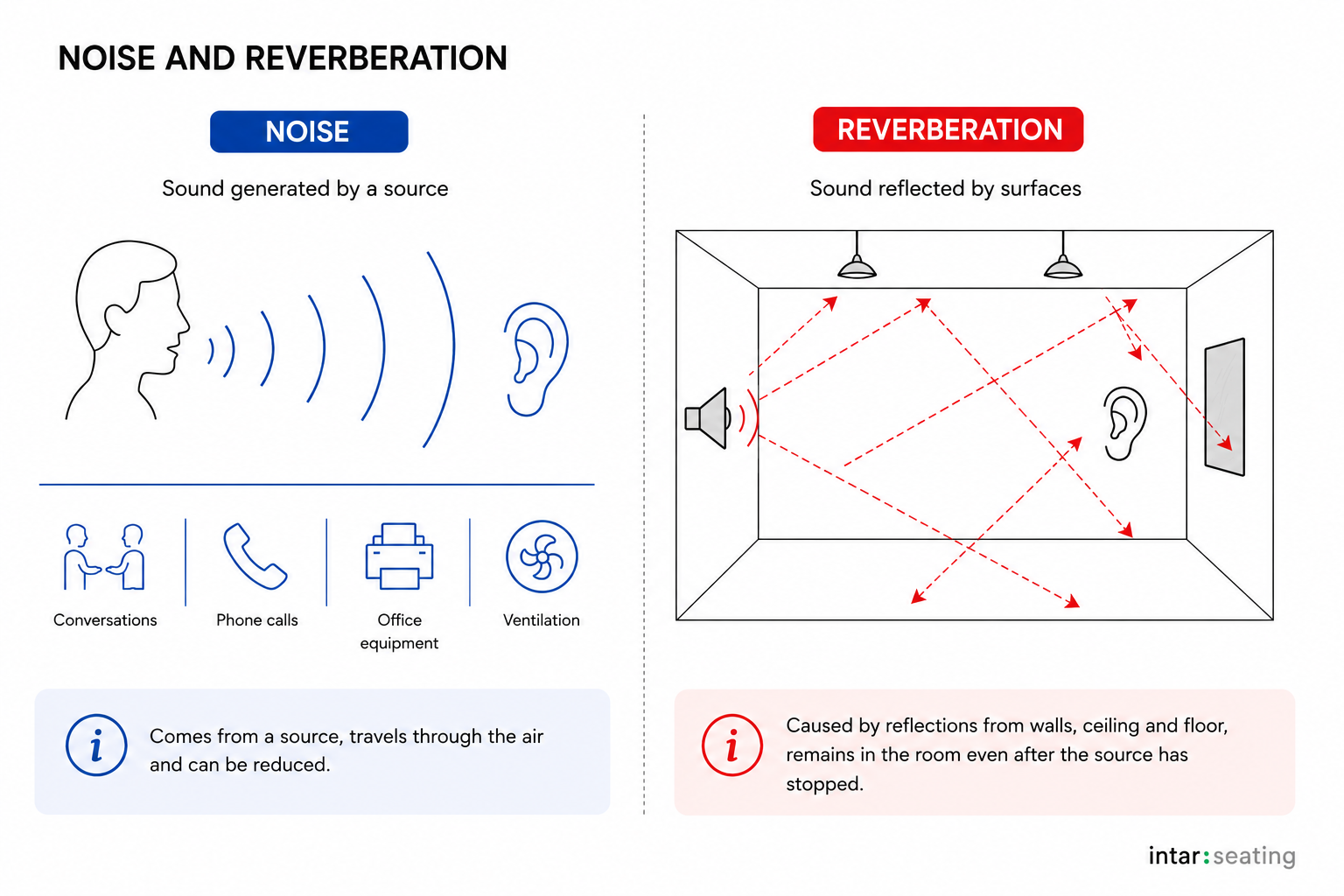
Noise and reverberation are often treated as interchangeable terms, but they describe two completely different phenomena.
Noise is an unwanted sound generated by a source, such as conversations, office equipment, ventilation systems or traffic outside the building. It can be measured and quantified.
Reverberation, on the other hand, is not a new source of sound. It occurs when sound waves repeatedly reflect from walls, ceilings, floors and other hard surfaces. The longer these reflections remain audible, the greater the reverberation.
This explains why two offices with similar noise levels may feel entirely different. In a room with excessive reverberation, conversations travel further, overlap and become distracting. In a well-designed acoustic environment, the same level of activity is perceived as significantly more comfortable.
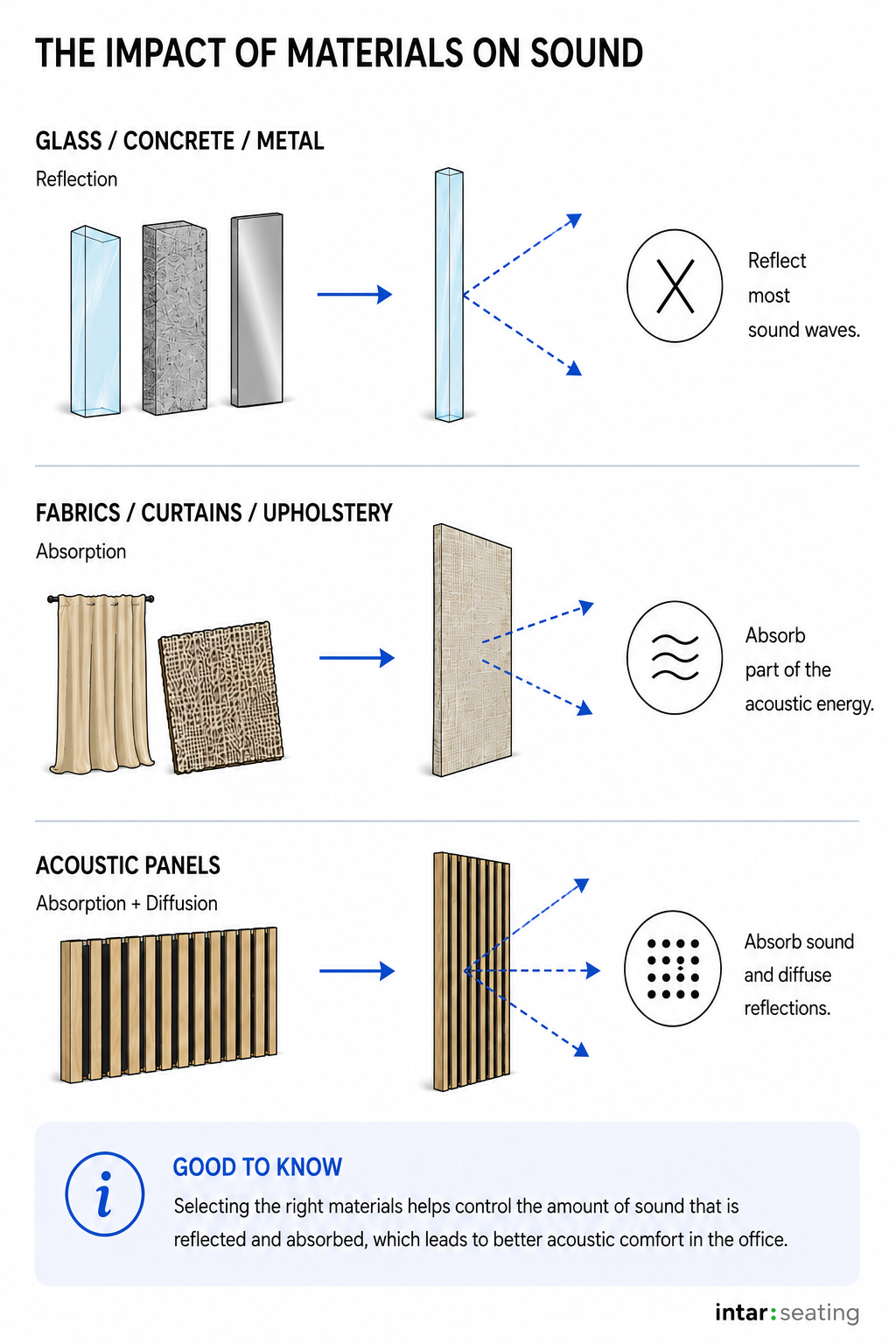
The materials used within an interior have a significant impact on its acoustic performance.
Glass, concrete, stone and metal surfaces reflect most sound waves, increasing the number of reflections within the room. Soft furnishings, textiles, carpets and specialist acoustic materials absorb part of the sound energy, reducing reverberation.
However, effective acoustic design is not about covering every surface with absorbent materials. The objective is to achieve an appropriate balance between sound reflection, absorption and diffusion.
The influence of acoustics on workplace wellbeing is often underestimated. Spending long periods in spaces with excessive reverberation can reduce concentration, increase fatigue and make conversations more demanding.
People also react naturally to noisy environments. As background noise increases, they instinctively raise their voices in order to be heard. This behaviour is known as the Lombard Effect and often results in a gradual increase in the overall noise level within an office.
Creating a comfortable acoustic environment requires a holistic approach. The size of the room, workstation layout, ceiling height, glazing, surface finishes and intended use of the space all influence the final result.
In practice, improving acoustics means reducing unwanted sound reflections and controlling the way sound travels throughout the room. This creates a more comfortable environment for focused work, conversations and collaborative activities.
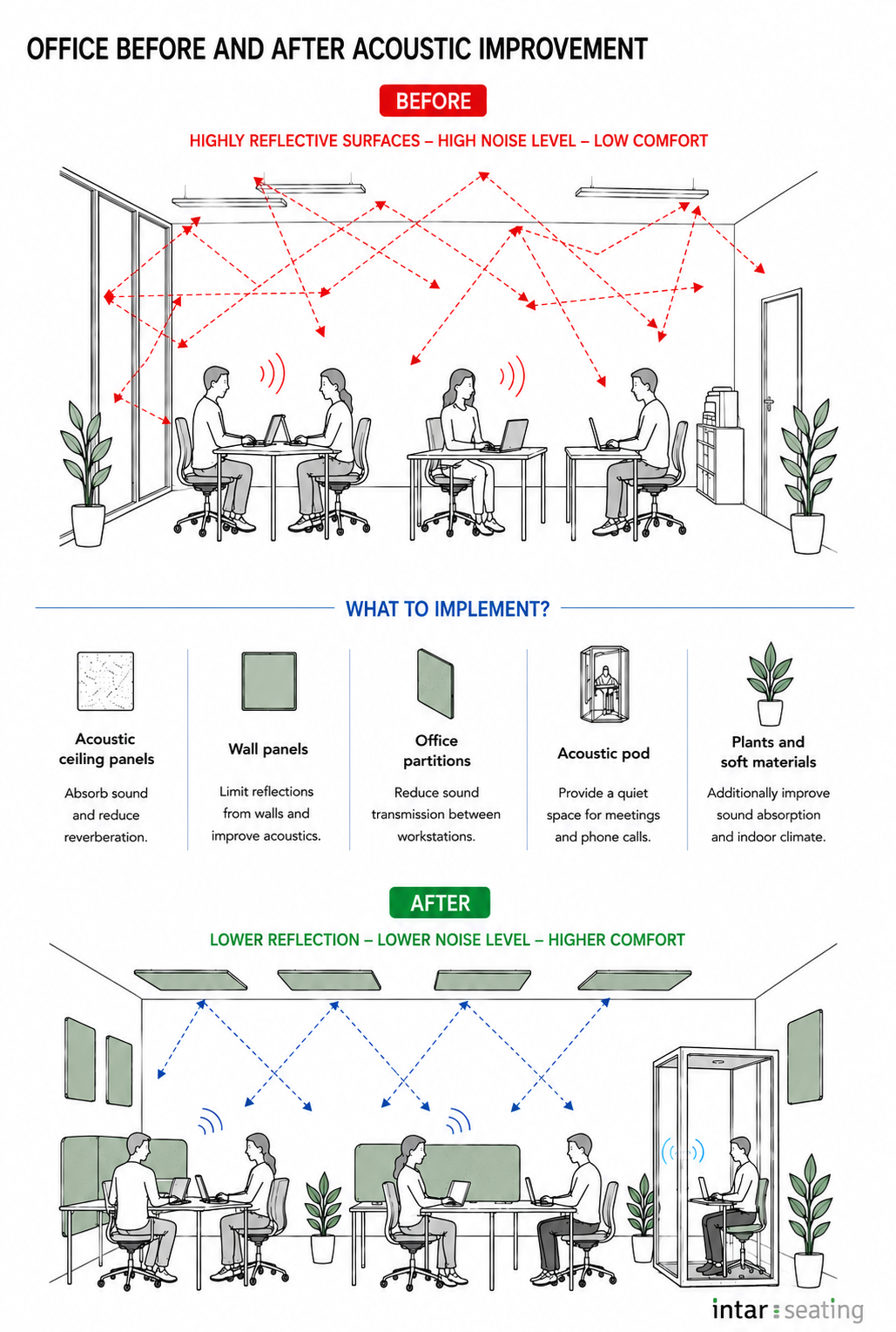
A wide range of solutions can be used to improve acoustic comfort in offices. These include wall and ceiling acoustic panels, desk-mounted screens, acoustic booths for phone calls and online meetings, and upholstered furniture designed to absorb sound.
Each solution serves a different purpose. The best results are achieved when they are selected as part of an overall acoustic strategy rather than as isolated additions to the workspace.
A more detailed overview of these solutions is provided in the fourth part of our publication series - "Acoustic Solutions for Modern Offices."
Acoustic comfort is one of the fundamental elements of a well-designed workplace. Understanding how sound behaves within a room makes it possible to create spaces that support concentration, improve speech intelligibility and provide a more comfortable working environment.
The next publication in this series explores the technical parameters used to assess room acoustics, including measurement methods and the principles applied when designing acoustically comfortable workplaces.

Intar Tools Sp. J.
ul. Szeroka 77
05-831 Parole
Poland



 Chairs and armchairs